

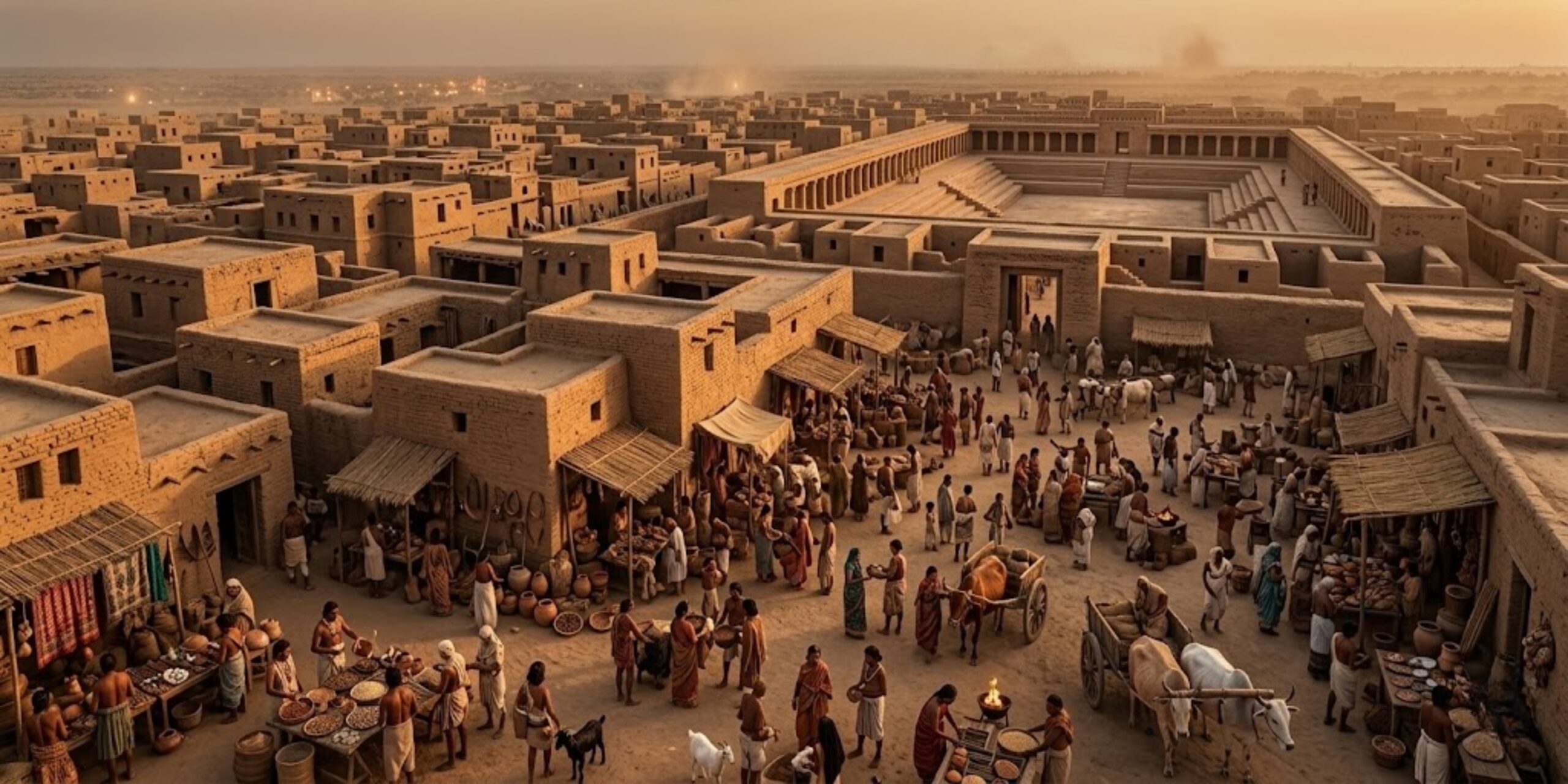
Long before the Romans built their aqueducts, a sophisticated civilization flourished in the basin of the Indus River. The Indus Valley Civilization, also known as the Harappan Civilization, was one of the three early “Cradles of Civilization,” alongside Egypt and Mesopotamia. Its largest and most famous city was Mohenjo-Daro, the “Mound of the Dead.”
What makes Mohenjo-Daro astonishing is its meticulous urban planning. The city was designed in a strict grid pattern, with streets meeting at right angles. The houses were built with uniform, baked mud bricks, and many featured multiple stories and bathing areas. Perhaps most impressive was the drainage system—an underground network of covered sewers that would not be equaled until modern times.
The civilization also possessed a writing system, a mysterious script found on small clay seals (like the ones being examined by the figures in image_0.png), which remains undeciphered to this day. This script, along with the “Great Bath,” a public water tank that might have had religious significance, are just two of the many enigmas that keep historians fascinated.
At Danistnama, exploring the rise and sudden decline of these lost cities is crucial for understanding the deep history of South Asia and the remarkable ingenuity of our ancestors.